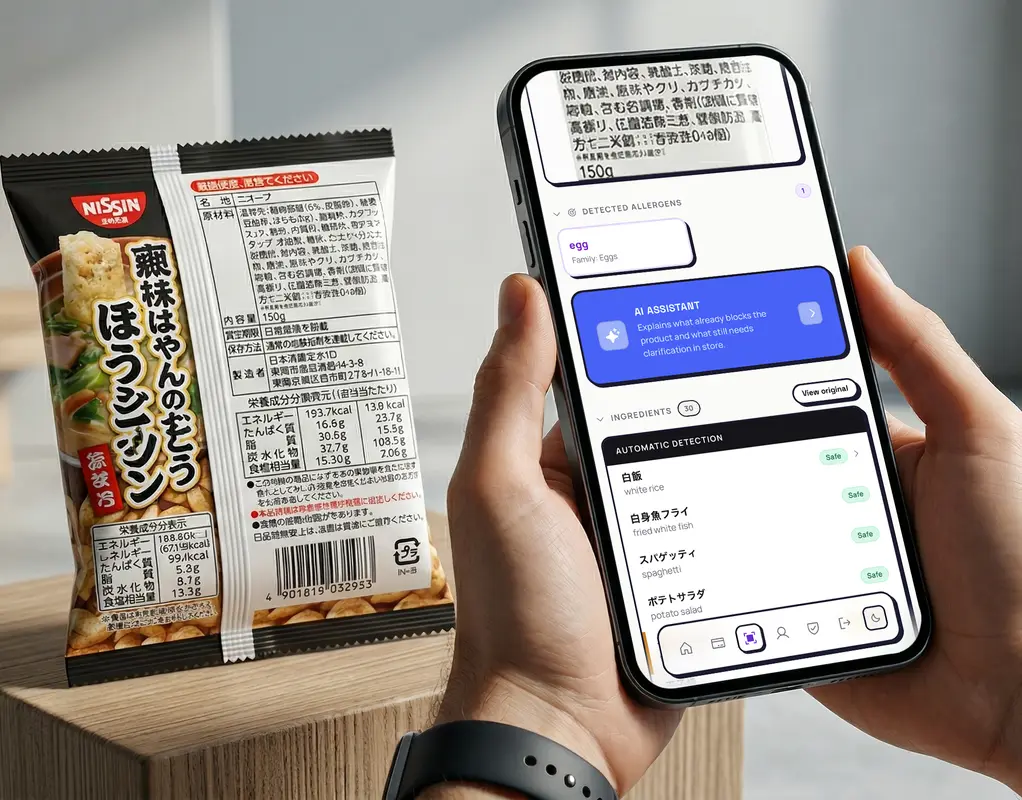
What should a Japanese ingredient scanning app actually do?
When someone looks for a Japanese ingredient scanning app, they rarely want a literal translation alone. What they really need is a fast way to decide whether a Japanese product fits their allergies, diet, or comfort level. Many tools stop too early: they read the image, but they do not help with the decision.
A useful app has to read the label, not just the photo
Reading a Japanese package properly means finding the real ingredient list, the nested ingredients inside parentheses, extracts, flavourings, additives, and factory notes. Without that step, the translation may look acceptable while the buying decision stays weak.
Translation should stay ingredient by ingredient
A genuinely useful app in Japan should preserve the ingredient structure. If everything is flattened into one translated paragraph, you lose the details that change the verdict: soy sauce, dashi, mirin, gelatin, milk, egg, peanut, traces, and more. Ingredient-by-ingredient translation is far more actionable than a generic summary.
The key difference is checking against your profile
The right tool should not stop at “here is the translation.” It should compare the label with your profile: soy, milk, peanuts, sesame, halal, vegan, vegetarian, gluten-free, and other criteria. That is what turns a translation tool into a practical Japanese ingredient scanning app.
Ambiguity is part of the real problem in Japan
Japanese labels often include generic terms such as 香料, 調味料, エキス, or very long lists with nested ingredients. A good app should not invent certainty when the wording stays vague. It should separate what is confirmed, what stays unclear, and what you still need to ask in store.
A strong app should also help you in store
When the label remains uncertain, the best next step is not a vague warning. It is a practical phrase you can show to staff in Japanese, plus romaji if needed. That store-facing assistance is a major part of what makes a Japanese ingredient scanning app genuinely useful during travel.
Where YumiScan fits
YumiScan was built for this exact use case: scan Japanese food labels, translate the ingredients in a way that stays usable, evaluate the product against your allergen or diet profile, and help you ask follow-up questions in store when needed. The goal is not only to translate Japanese, but to make food decisions clearer in Japan.
In short
If you are comparing apps to scan Japanese ingredients, look for four things: reliable label reading, ingredient-by-ingredient translation, a verdict based on your profile, and practical help when the label stays ambiguous. That combination is what saves time and makes shopping in Japan safer and less stressful.
Take the next step
Give your next purchase a smarter label check
Create your YumiScan account, add your allergen profile, and let AI decode the label before you buy. Your first 3 scans are free.
Create my account